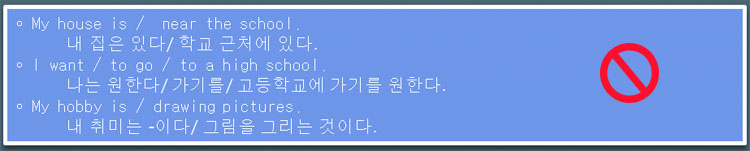
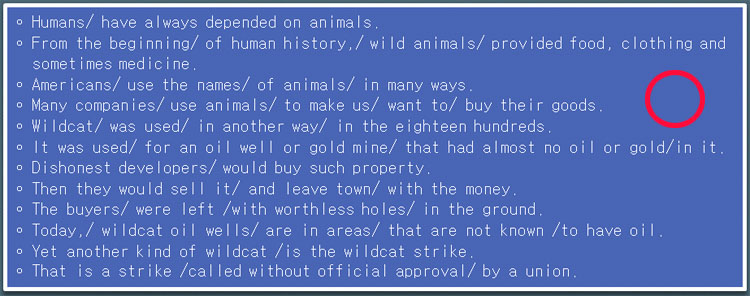
다음은 미국 VOA 와 Lida Baker(캘리포니아 대학교 미국언어센터에서 강의중)의 의미단위에 대한 인터뷰 내용입니다.
Lida Baker도 정확히 의미단위로 분할하는 규정은 없다고 합니다.
그것은 원어민의 입장에서 너무나 자연스럽기 때문에 의미단위에 대한 구분 및 휴지점이 발생하는 원리를 정확하게 파악하지 못할
수 도 있습니다.
AA: I'm Avi Arditti with Rosanne Skirble, and this week on Wordmaster --
English teacher Lida Baker in Los Angeles talks about improving English
pronunciation by understanding the idea of thought groups.
RS: Thought groups are something we don't even think
about as native speakers of English.
It's a way to break long sentences into shorter pieces,
separated by slight pauses, to help listeners organize the meaning.
의미단위는 긴문장을 짧은 조각단위로 나누는 방식으로 짧은 휴지점에 의해
분할되고 또한 청취자들이 의미를 구성
하도록 돕습니다.
AA: But English learners need help to develop this skill when they study
pronunciation. Lida says over the last twenty years,
many teachers of English
have come to focus not just on vowels and consonants, but also on stress and
intonation.

BAKER: "So we're talking about the way that the voice
moves up and down and where we pause and things of that sort.
This is a much
more authentic way of learning about spoken language."
RS: Take a sentence like: "I took the milk from the table and I put it in
the refrigerator."
BAKER: "This is not right: [robotic monotone] 'I took
the milk from the refrigerator and I put it on the table.' Nobody talks like
that."
AA: "You sound like a robot."
BAKER: "That's right. But that's not how we speak
English. What we do is, the voice moves up and down, and there's also an
alternation between syllables that are stressed and pronounced clearly, and
syllables that are unstressed and therefore
are reduced and spoken very quickly.
So 'I took the milk' becomes 'I took the milk,'
puh-PAH, puh-PAH, OK? So within each thought group you will also find
that there
are these variations in pitch, with the voice moving up and down, and then
syllables that are pronounced more
clearly, syllables that are reduced and
pronounced unclearly. So you get this effect of 'I took the milk,' puh-PAH,
puh-PAH,
'from the table,' puh-puh-PAH-PAH, 'and I put it,' da-da-DAH-DAH, 'in
the refrigerator,' puh-puh-PAH-puh-puh-puh."
AA: "You've got a hit there!"
BAKER: "Funny you should say that, because one of the easiest ways to learn
about thought groups is to listen to popular music. And it happens that my
daughter is absolutely crazy about the Beatles and she plays the guitar, so
yesterday she was
singing 'Can't Buy Me Love.'"
MUSIC: "Can't Buy Me Love"
Can't buy me love, love,
Can't buy me love
I'll buy you a diamond ring my friend if it makes you feel alright
I'll get you anything my friend if it makes you feel alright
'cause I don't care too much for money, money can't buy me love ...
BAKER: "First of all 'can't buy me
love,' that's a thought group right there.
'I'll buy you a diamond ring, my friend,' -- so,
'I'll buy you,' 'a
diamond ring, 'my friend.'
That's three thought groups right
there."
RS: "What about for those who speak English as a foreign language, are
there some rules, or do they have to learn by doing."
의미단위를 만드는 규칙이 있는가?
BAKER: "Well, I can't give you any rules, but I can
give you some guidelines.
음...어떠한 규칙도 줄 수 없지만 가인드라인은 줄 수 있다.
Generally speaking, the pauses occur, they sort of
correspond to grammatical units such as phrases and clauses and
things like the
complete subject of a sentence.
일반적으로 휴지기간은 문법적인 단위에 해당하는 구나 절 또는 문장의 주어전체와 같은 것들이다.
So if you have a sentence like
'a big black cat sat on a tall white fence.'
So the subject there is 'a big
black cat,' and that's a thought group. 'A big black cat sat on a tall
white fence,' 'on a tall
white fence is also a
thought group, and that's a prepositional phrase.
"Now pop music isn't the only way to learn this. A
great way to learn this, I'm going to put in a plug here for the Voice of
America -- is to go the Special English broadcasts and look at the transcripts
and then listen to the announcers. Because
on Special English the language is
slowed down, it's a wonderful way for learners to pick up on the way sentences
are
broken down into thought groups.
"Another way is to use a video cassette recorder and
tape any television program and do something called tracking.
You tape a segment
of a show and then you play it back and what you try to do is to imitate what
they're saying, just one
beat behind them. And incidentally it doesn't have to
be done with television. It can be done with radio as well."
RS: "Anywhere there's sound going on in English."
BAKER: "That's right!"
AA: Lida Baker teaches at the American Language Center at the University of
California at Los Angeles. She also writes and
edits textbooks for English
learners. And, by the way, those Special English programs she mentioned are all
available
online at voaspecialenglish.com.


















 HOME
>
HOME
>